
The Real Reason Drumming Feels So Healing
Dec 09, 2025
Most people think drumming feels healing because it’s expressive or cathartic.
But the real reason sits much deeper in the body.
When you play a steady rhythm, your brain begins syncing its internal timing networks to the pulse through neural entrainment [1].
This alignment reduces the brain’s need to predict what comes next, which lowers the load on threat-detection systems and creates a sense of internal ease [2].
What feels like “healing” is often your nervous system finally getting to stop bracing.
How Rhythm Organizes Your Mind and Body
You can feel this shift in your hands before you feel it in your thoughts.
The strikes become more even.
Your breath starts following a natural rhythm.
Your attention narrows to the beat instead of everything else competing for it.
This isn’t a metaphor.
Studies on rhythm and attention show that predictable groove structures reduce cognitive load and support clearer focus [3].
In other words, the beat organizes your mind for you.
Then something else kicks in—movement.
When your arms fall into a repeating motion, your motor system links the movement to the rhythm, strengthening coordination between sensory and motor networks [4].
This creates a body-level stability that your brain interprets as safety.
And once the body feels safe, emotional regulation follows.
Why Healing Deepens When You Drum With Others
But the biggest healing effect doesn’t come from playing alone.
It comes from playing with other people.
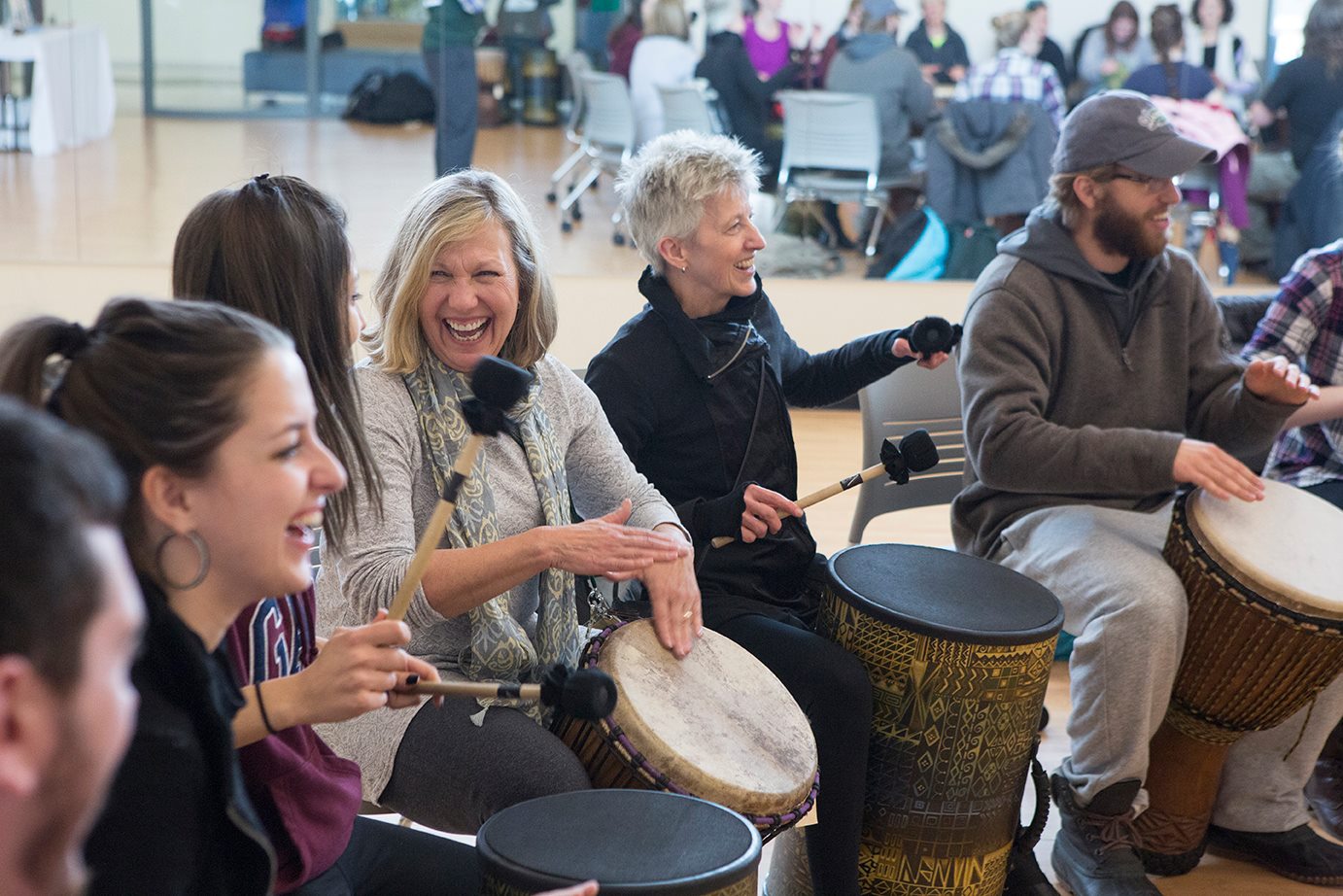
When a group lands on the same pulse, their movements begin syncing in subtle but powerful ways—hands rising and falling in matched timing, breath settling into similar rhythms.
Research on interpersonal synchrony shows that this kind of shared timing increases endorphins, fosters bonding, and reduces anxiety [5].
The healing people feel isn’t abstract connection.
It is literal, measurable biochemistry.
Koole and Tschacher’s work adds that synchrony also reduces sympathetic activation, which is the part of the nervous system responsible for the stress response [6].
That means group drumming doesn’t just feel calming.
It is calming.
Inside the body, heart rhythms respond too.
Studies on heart-rate variability show that steady group rhythm can help align heart-rate patterns among participants, creating more balanced autonomic regulation [7].
Combined with research showing that rhythm-supported breathing increases vagal tone and downshifts stress physiology, the picture becomes clear [8].
How Rhythm Helps You Settle, Soften, and Feel Whole
Drumming feels healing because it creates a rare moment when breath, heart, brain, and movement fall into the same lane.
And when that happens inside a group, the nervous system receives a flood of cues that say, “You’re safe enough to soften now.”
That’s what people feel but often can’t describe.
It’s not the volume.
It’s not the speed.
It’s the alignment.
The rhythm lines up the systems that stress usually scatters.
In closing, here’s what to remember:
A steady beat calms the brain.
Shared timing reduces anxiety.
Movement stabilizes the body.
Breath and heart fall into rhythm.
And together they create the state we call healing.
References
[1] Nozaradan, S., et al. (2012). Neural entrainment to rhythm. Journal of Neuroscience.
[2] Koelsch, S. (2014). Music and the limbic system. Nature Reviews Neuroscience.
[3] Janata, P., et al. (2012). Groove regulates attention. Frontiers in Psychology.
[4] Thaut, M. (2021). Rhythm, brain, and motor control.
[5] Tarr, B., Launay, J., & Dunbar, R. (2014). Synchrony and bonding. Biology Letters.
[6] Koole, S. L., & Tschacher, W. (2016). Synchrony and anxiety reduction. Current Opinion in Psychology.
[7] Vickhoff, B., et al. (2013). Heart-rate synchrony in group rhythm. Frontiers in Psychology.
[8] Meyer, M., et al. (2019). Rhythm, breath, and regulation. Frontiers in Human Neuroscience.
Author
