
How One Groove Stopped the Anxiety Spiral
Dec 09, 2025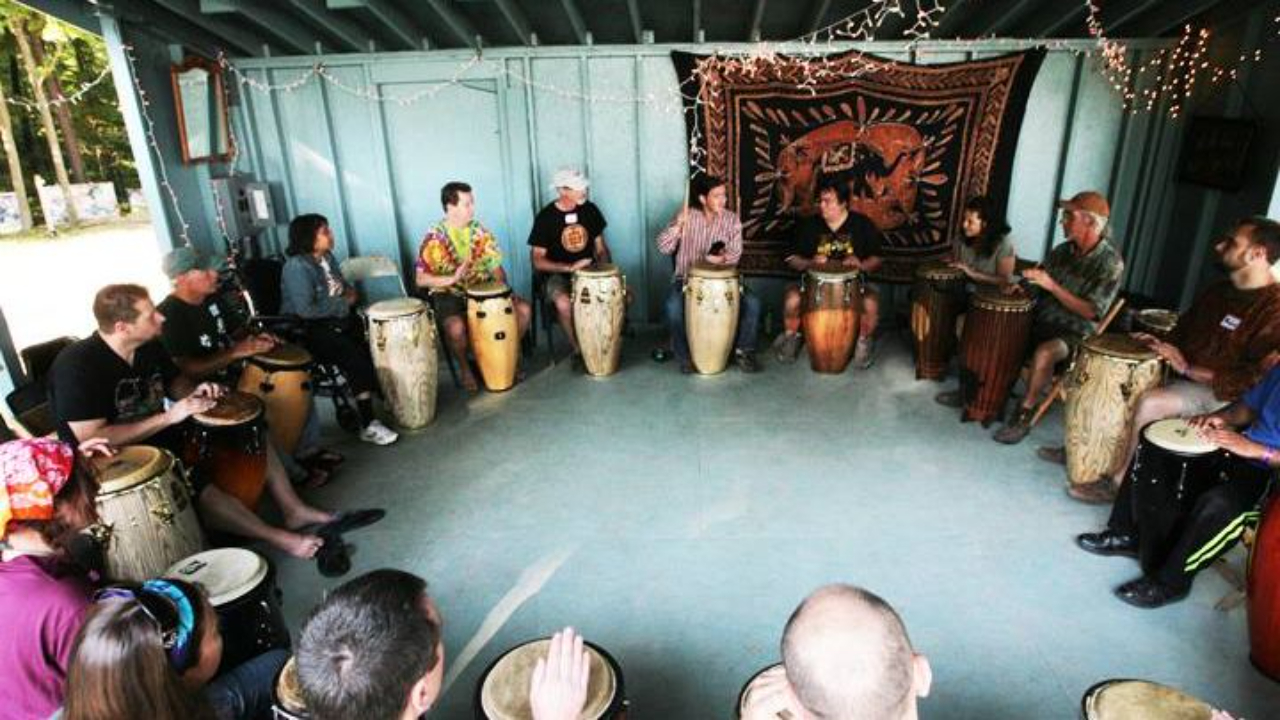
The first time I saw it happen, we were maybe four minutes into a groove.
One participant had come in buzzing—fast talking, restless hands, eyes scanning the room like her thoughts were trying to outrun each other.
You could feel the momentum of it.
The kind of mental spiral that doesn’t need a trigger; it just builds on its own.
We started with one hand-to-drum pattern.
Low.
Steady.
No tricks.
Just … boom … boom … boom.
After about a minute, something shifted.
Her hands found a more even arc.
Her breathing slowed.
Her attention, which had been skittering across the room, began resting on the pulse.
One simple groove interrupted the anxiety spiral.
Research shows why this happens.
Group drumming reduces stress hormones and increases immune markers like natural killer cell activity [1].
Group music-making more broadly is linked to significant cortisol reductions and decreased anxiety during shared rhythmic activity [2].
These shifts aren’t psychological guesses—they are measurable, physiological changes.
A major mechanism is predictability.
Neural entrainment research shows that the brain’s timing networks automatically lock onto steady rhythmic pulses [3].
Once the pulse becomes reliable, the brain doesn’t have to burn energy predicting when the next beat will land.
Reduced uncertainty means less activation in threat-detection pathways [4].
The groove becomes something the nervous system can trust.
There’s also cognitive load.
Predictable rhythm reduces how much information the brain must decode.
Studies show that simple, repeating rhythmic structures support better attention and require less effortful processing than constantly changing ones [5].
In that state, the groove is doing the organizing.
The player doesn’t have to.
Then the group effect kicks in.
 When people lock into the same pulse, they begin to move in synchrony—hands rising and falling in similar timing, bodies rocking in a shared arc.
Synchrony research from Tarr, Launay, and Dunbar shows that moving rhythmically with others increases endorphins, boosts bonding, and reduces anxiety [6].
Koole and Tschacher’s work adds that synchrony also lowers anxiety and increases interpersonal ease [7].
This means people are not regulating alone.
Their nervous systems get social support the moment timing aligns.
Inside the body, the heartbeat and breath begin adjusting too.
Studies on heart-rate synchrony show that group rhythm can align heart-rate variability across participants, a key marker of autonomic regulation [8].
Research on rhythmic breathing shows that steady pulse helps stabilize breath cycles and supports increased vagal tone [9].
Slow, steady rhythm has also been shown to increase parasympathetic activity—the branch of the nervous system responsible for downshifting stress [10].
From the outside, it looks like a circle playing a simple rhythm.
Inside the body, everything is recalibrating.
Breath, heart, and attention begin moving in the same lane.
That day, the participant didn’t describe any of this.
She simply looked up, took a slower inhale, and said, “I’m not racing anymore.”
One groove didn’t solve her problems.
But it interrupted the spiral long enough for her nervous system to find another state.
A steady, shared rhythm gives the brain less to decode, more to predict, and a social structure that softens the load.
With enough repetition, a groove becomes more than a pattern.
It becomes a practical way to catch the spiral mid-flight and change its direction.
Reference List
[1] Bittman, B., et al. (2001). Composite effects of group drumming. Alternative Therapies, 7(1), 38–47.
[2] Fancourt, D., et al. (2016). Music-making lowers cortisol. Psychoneuroendocrinology.
[3] Nozaradan, S., et al. (2012). Neural entrainment to rhythm. Journal of Neuroscience.
[4] Koelsch, S. (2014). Music and the limbic system. Nature Reviews Neuroscience.
[5] Janata, P., et al. (2012). Groove regulates attention and body states. Frontiers in Psychology, 3, 532.
[6] Tarr, B., Launay, J., & Dunbar, R. (2014). Synchrony and bonding. Biology Letters, 10(10).
[7] Koole, S. L., & Tschacher, W. (2016). Synchrony and anxiety reduction. Current Opinion in Psychology.
[8] Vickhoff, B., et al. (2013). Heart-rate synchrony in group rhythm. Frontiers in Psychology, 4, 334.
[9] Meyer, M., et al. (2019). Rhythm, breath, and regulation. Frontiers in Human Neuroscience, 13, 352.
[10] Wachi, M., et al. (2007). Taiko drumming and autonomic balance. Journal of Physiological Anthropology.
Author
